Triathlon
Choosing Your Bike for Your First 70.3
For a first 70.3, a road bike that fits, with clip-on aero bars, usually beats a new tri bike. Fit, position and pacing matter most.
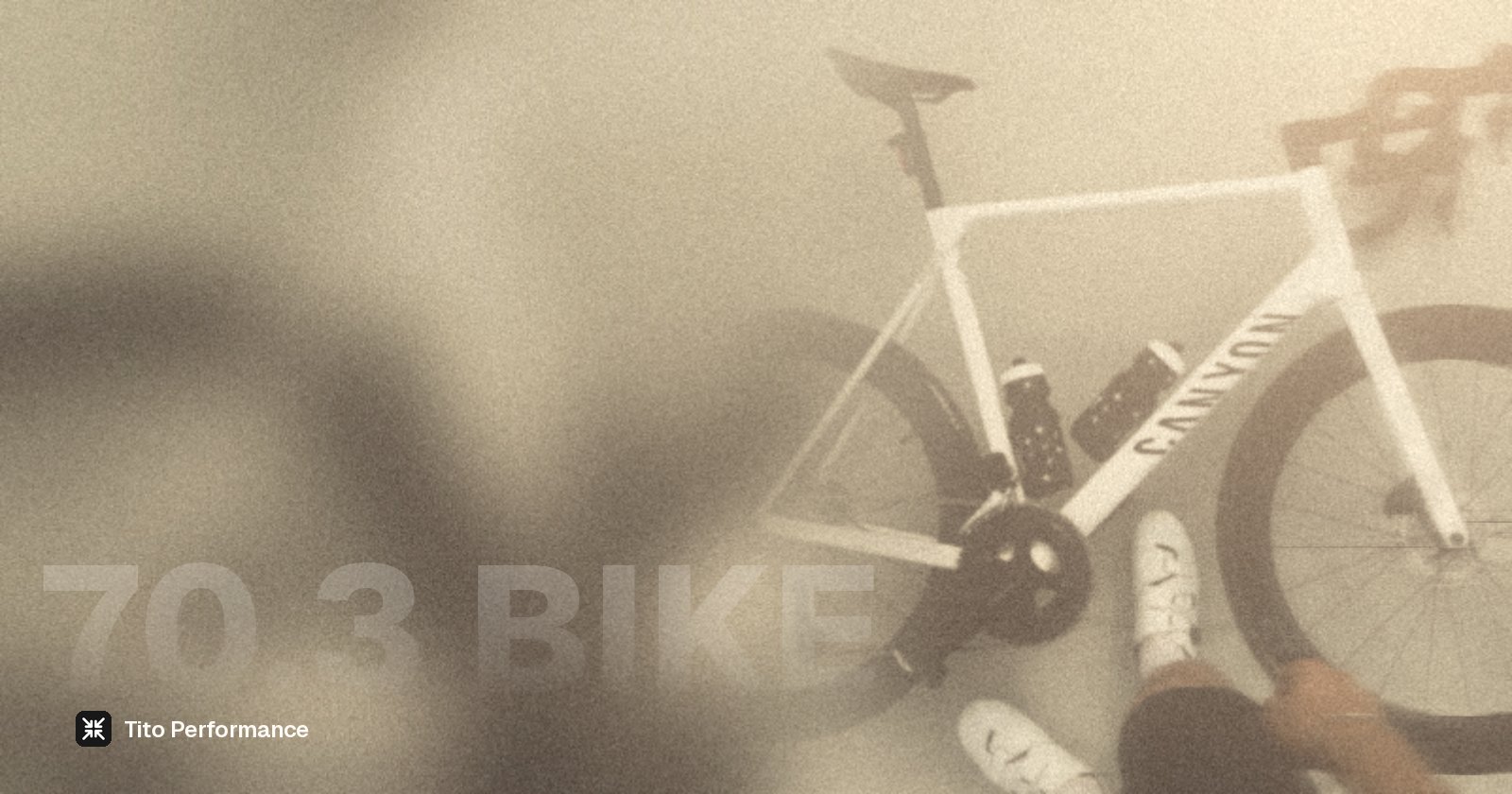
Short answer: for most people doing a first 70.3, our recommendation is a road bike that fits you well, set up by a bike fitter, with clip-on aero bars you can hold comfortably for long stretches. A dedicated triathlon bike can be faster, mainly because it puts you in a lower, narrower position. On flat roads much of your effort goes into pushing air out of the way, and the lower and narrower you sit, the less air you push. How much time that saves depends on you and the course, and we have no reliable figure for an amateur. As a rule of thumb, a position you can hold for 90 km and still run afterwards beats a more aggressive one you abandon after an hour.
That matters because a first 70.3 is often when people consider spending a lot on a bike. Fit, comfort and a few simple upgrades usually give more back for less money.
Which bike should you choose?
A road bike that fits, with clip-on aero bars, set up properly. If you already own one that fits, keep it.
Why this is the default:
- It is the more versatile bike. You can ride it in groups, on hilly roads and in winter, and it is easier to handle and climb on.
- It lets you learn the aero position gradually. Clip-on bars give you a lower, narrower position for flat sections, and you can sit up with your hands on the brake levers when you need to.
- For most first-timers, fit and position are likely to give more than a new frame. A bike you can ride comfortably for three hours or more is worth more than a few minutes of theoretical speed.
A triathlon or time-trial bike makes sense if you already ride a lot, plan to race several non-drafting triathlons (where you may not ride in another rider's slipstream, like most 70.3s), live somewhere flat, and can hold an aero position comfortably. It is a specialist tool: often faster on flat and rolling courses, harder to handle in groups, on descents and in crosswinds (the brakes are further from your hands in the aero position), and harder to fit well.
What matters most depends on where you are:
- If you're new to cycling, spend your money and time on fit, a comfortable saddle, and riding more. Learn to ride steadily on your own for 2–3 hours before worrying about aero.
- If you're an experienced cyclist, a careful fit with aero bars, and practice holding that position, is likely the cheapest speed you can buy.
Other options
A triathlon bike from the start. See the conditions above; try one for fit before buying, and budget for a proper fit.
An endurance or gravel bike. If that is what you own, it will do. Swap any off-road tyres for good road tyres, consider clip-on bars if the fitter agrees, and focus on pacing.
Hiring a bike for race weekend. Possible, but bring your own pedals (and saddle if you can) and your fit measurements, and ride it, including on the aero bars, before race day. A first 70.3 is not the time to try a new position.
Why your position matters so much
On flat roads at race speed, air resistance is the main force you work against. Above about 50 km/h it takes about 90% of your power (1). Almost all amateurs ride a 70.3 well below that speed, so the share is lower, but on flat roads air is still, as a rule of thumb, the largest force you work against, and its share grows the faster you go. How much air you push depends on the shape and size you and the bike present to the wind in your riding position, which researchers call effective frontal area (1).
That is why a lower, narrower position on aero bars can make a real difference. But there is a trade-off. Research on cycling position says comfort and body mechanics must be weighed against aerodynamics (2, 3). The fastest position on paper is not the fastest over 90 km if you keep sitting up because your neck or back hurts.
What does the bike leg do to your run?
What to do: ride the bike easier than feels necessary, and practise short runs off the bike in training. Running after cycling usually feels harder than running fresh. One older review, mostly drawing on Olympic-distance triathlon, found running cost more energy after the bike (4). A more recent systematic review found most studies showed worse running afterwards, but methods varied too much to say for sure whether, or why, the bike affects the run (5). The figures are in the science section below.
What this means for your bike choice: there is no strong evidence that any frame or seat angle on its own makes your run faster. Many coaches believe a steeper, more forward saddle on a triathlon bike helps the run. The main review of cycling position reported findings for saddle fore-aft position, which a steeper seat angle changes, but it looked at effects on the bike, not on the run that follows (2). Treat the idea as plausible but unproven. Pacing probably matters more: one review of triathlon performance notes that steadier pacing on the bike may leave a "metabolic reserve" for the run in long-distance events (6). As a rule of thumb for a first 70.3, ride steadily at an effort where you could still speak in short sentences, comfortably below the hardest effort you could hold for an hour. Ride the first 20–30 minutes easier still, and resist surging on hills.
How to set up your bike for a 70.3
This is the recommended version for most first-timers:
- Get a professional bike fit, ideally before you buy if you are buying new. Tell the fitter it is for a 70.3 and how long you can currently ride comfortably.
- Start with saddle height. Reviews find it is among the settings with the clearest evidence (2), and that it affects performance and knee loading, though the injury evidence is weaker (7, 8). Your knee should stay slightly bent at the bottom of the pedal stroke. Leave the measuring to the fitter: different methods give different numbers (8).
- Add clip-on aero bars, and let the fitter adjust the rest. On a road bike, the aero position closes your hip angle, so the fitter may move the saddle forward or change the stem (the part joining the handlebars to the frame) before lowering the front. As a rule of thumb, make small changes, a few millimetres at a time, and ride at least a week between them. Avoid position changes in the last three to four weeks before the race.
- Practise the position gradually. Start with a few 5–10 minute spells on the aero bars during easy rides and add a few minutes each week, until you can hold them for most of a long ride on flat and rolling roads. Mild neck or back tiredness is normal at first. Numbness, tingling or sharp pain is not: come out of the position and see your fitter.
- Choose gearing for the course. If the race is hilly, a wider range of gears (easier low gears) lets you keep a steady effort on climbs instead of grinding, which helps save your legs for the run. Check the course profile.
- Fit good tyres and check the bike over with a mechanic a few weeks before race day. Race on tyres you have already ridden.
- Ride your race position in training. As a rule of thumb, in the last 8–10 weeks, follow a long ride every week or two with an easy 10–20 minute run, and do a few of those rides in race kit, on race tyres, in the aero position.
Safety: use the aero bars only on quiet roads with a clear view ahead. Sit up and hold the brakes in groups, in traffic, on descents, on technical corners and in strong crosswinds.
What to upgrade, and in what order
Spend money in this order, as a rule of thumb:
- Bike fit. Comfort and the ability to hold a position matter most.
- Saddle, bar pads and shoe cleats, if the fit shows you need them. These are the places your body meets the bike.
- Tyres. Good tyres are a cheap way to gain speed; choose ones that balance low rolling resistance with enough puncture protection for your roads.
- Aero helmet and close-fitting race clothing. These can reduce the shape you present to the wind (1), though an aero helmet helps most if you keep your head still. For hot races, choose one with ventilation.
- Deeper wheels or a triathlon bike, last, and only if you have done the rest.
Buying second-hand
A good second-hand road bike or triathlon bike can be excellent value. Check:
- Size first. A bargain in the wrong size is not a bargain. Ask a fitter which frame sizes suit you before you shop.
- The frame. Look closely for cracks and damage around the joints. Ask whether it has been crashed. Damage to carbon is often invisible, so have a mechanic inspect any carbon frame, handlebars and seatpost before you pay.
- Wear on the gears and brakes. A new chain, rear gear cluster, cables or brake pads add to the real price.
- That it suits your race. Disc brakes, gearing range and tyre clearance matter more than the brand.
Race rules worth knowing
Most 70.3 races are non-drafting: you must stay well behind the rider in front unless you are overtaking. Riding close behind someone cuts air resistance a great deal (9), and a review of triathlon lists drafting as a performance gain where it is allowed (6); non-drafting races ban it. Rules also usually require a helmet, a bike in safe working order and plugs in the ends of the handlebars. The exact rules, including the drafting distance and penalties, vary by race and organiser, so read your race's rulebook before race day.
The science behind it
This part is optional reading.
The physics is well established: at high speeds, air resistance dominates the forces a cyclist must overcome, and it depends on the product of frontal area and a drag coefficient, together called effective frontal area (1). Field methods to estimate it are cheap and agree reasonably with wind-tunnel testing (1).
The evidence on bike fit is thinner than many people assume. A systematic review screened over 16,000 studies and fully analysed 47: none was rated good quality, and most were poor. Clear findings existed for saddle height, trunk angle and saddle fore-aft position, with no clear recommendations for crank length, handlebar height or cleat position (2). An earlier review of saddle height found many methods in use and none clearly established, with more evidence on performance than on injury (7). A consensus of 14 experts agreed on how bike dimensions should be measured, which helps fitters and researchers compare like with like (10). On comfort, a study of 20 cyclists riding 45 minutes at an easy effort, without aero bars, found an upright trunk the most comfortable; the authors noted this applies where aerodynamics matters less, and that riders' own sense of comfort should count when choosing a position (3). One fitting review gives a knee bend of roughly 30–40 degrees at the bottom of the pedal stroke when measured while riding (8).
On the bike-to-run transition, a review of Olympic-distance triathlon, written for junior and elite triathletes, found the energy cost of running after the bike was 1.6% to 11.6% higher than in a normal run, depending on the athlete's level, with a more forward-leaning trunk the most significant change in running form (4). The more recent systematic review of 39 studies found most showed worse performance after cycling, but because methods varied so much it could not say for sure whether, or why, prior cycling affects running (5).
References
- Debraux P, Grappe F, Manolova AV, et al. Aerodynamic drag in cycling: methods of assessment. Sports Biomech. 2011. doi:10.1080/14763141.2011.592209
- Husband SP, Wainwright B, Wilson F, et al. Cycling position optimisation - a systematic review of the impact of positional changes on biomechanical and physiological factors in cycling. J Sports Sci. 2024. doi:10.1080/02640414.2024.2394752
- Priego Quesada JI, Pérez-Soriano P, Lucas-Cuevas AG, et al. Effect of bike-fit in the perception of comfort, fatigue and pain. J Sports Sci. 2017. doi:10.1080/02640414.2016.1215496
- Millet GP, Vleck VE. Physiological and biomechanical adaptations to the cycle to run transition in Olympic triathlon: review and practical recommendations for training. Br J Sports Med. 2000. doi:10.1136/bjsm.34.5.384
- Rico Bini R, Canal Jacques T, Hunter J, et al. Biomechanical and physiological implications to running after cycling and strategies to improve cycling to running transition: A systematic review. J Sci Med Sport. 2022. doi:10.1016/j.jsams.2022.07.006
- Bentley DJ, Cox GR, Green D, et al. Maximising performance in triathlon: applied physiological and nutritional aspects of elite and non-elite competitions. J Sci Med Sport. 2008. doi:10.1016/j.jsams.2007.07.010
- Bini R, Hume PA, Croft JL. Effects of bicycle saddle height on knee injury risk and cycling performance. Sports Med. 2011. doi:10.2165/11588740-000000000-00000
- Swart J, Holliday W. Cycling Biomechanics Optimization-the (R) Evolution of Bicycle Fitting. Curr Sports Med Rep. 2019. doi:10.1249/jsr.0000000000000665
- Beaumont F, Murer S, Bogard F, et al. Aerodynamic drafting in mass-start non-motorized sports: A systematic review. J Biomech. 2025. doi:10.1016/j.jbiomech.2025.112641
- Priego-Quesada JI, Arkesteijn M, Bertucci W, et al. Bicycle Set-Up Dimensions and Cycling Kinematics: A Consensus Statement Using Delphi Methodology. Sports Med. 2024. doi:10.1007/s40279-024-02100-6
Training and nutrition that fit your life
For self-coached athletes, a plan that adapts to how your week actually went. For coaches, your whole squad in one place.
Discover Tito